

Have you ever known exactly what you needed to do, yet found yourself doing almost anything else instead?
You may have made a plan, written a list or promised yourself that tomorrow would be different. Perhaps you genuinely want to make the change. And yet, when the moment arrives, something seems to stop you.
It can be incredibly frustrating, especially when you are an intelligent, capable person who understands the situation perfectly well. You may begin to wonder whether you are lazy, lacking in motivation or simply not trying hard enough.
But knowing what to do and being able to do it are not always the same thing.

It isn’t necessarily a lack of willpower
We often assume that change should be straightforward.
If we want to become healthier, we should exercise more. If we feel unhappy at work, we should look for another job. If a relationship or situation is causing us distress, we should set clearer boundaries. If we have an important task to complete, we should stop procrastinating and get on with it.
From the outside, or to other people, the answer can sometimes appear obvious.
Yet human behaviour is rarely governed by logic alone. Our choices are also influenced by our emotions, previous experiences, beliefs, expectations and the associations we have formed over time.
Part of you may genuinely want to move forward while another part associates change with risk, discomfort, rejection or failure. Even positive change can take us into unfamiliar territory, and the familiar often feels safer simply because it’s what we already know.
This can create an inner conflict:
“I want things to change, but I don’t feel able to take the next step.”
You may be avoiding a feeling, not the task itself
Sometimes, what looks like procrastination is actually an attempt to avoid an uncomfortable feeling.
You might put off making a telephone call because you are worried about how the other person will respond. You might delay applying for a new job because the application brings up doubts about whether you are good enough. You might avoid beginning an important project because you fear that the result will not live up to your expectations.
The task is not necessarily the real problem. The feelings connected to it may be what you are trying to escape.
Research into procrastination supports this idea. Psychologist Dr Fuschia Sirois describes procrastination as an emotional regulation issue rather than simply laziness or poor time management. Avoiding a task may provide short-term relief from anxiety, boredom, self-doubt or frustration, even though it often creates more stress later. This is sometimes described as a secondary gain: the immediate relief or benefit we experience from avoiding the task.
This explains why telling yourself to “just get on with it” does not always work. It addresses the behaviour without exploring what is driving it.
Your mind may be trying to protect you
Many of the patterns that hold us back began as ways of protecting us.
Perhaps you learnt that keeping quiet helped you avoid criticism. Maybe staying in the background to reduce the risk of being judged. Perhaps perfectionism helped you gain approval, or avoiding difficult situations gave you temporary relief from anxiety.
These responses may once have been understandable or even useful. The difficulty comes when an old protective pattern continues long after the original circumstances have changed. And we often find ourselves doing things in adulthood that worked when we were children but are no longer appropriate.

You may consciously know that you are capable, yet still experience an automatic fear of getting things wrong. You may know that one person’s opinion does not define you, yet still feel deeply affected by the possibility of disapproval.
Your conscious understanding has changed, but an older emotional pattern may still be operating in the background.
That does not mean that you are broken or deliberately sabotaging yourself. It may simply mean that a part of you has not yet realised that you have more choices now.
The beliefs beneath the behaviour
When we repeatedly struggle to do something, there may be a belief sitting quietly beneath the surface.
It could sound like:
- I’m not good enough
- I’ll probably fail
- People will judge me
- I’m too old to change
- I don’t deserve to succeed
- I have to do it perfectly
- It’s safer not to try
- People like me don’t do things like that
We do not always recognise these as beliefs. To us, they can feel like facts.
A belief such as “I always mess things up” may cause someone to hesitate, overprepare or avoid starting altogether. If they do not begin, they cannot fail. Unfortunately, they also cannot discover what might happen if they succeed, and over time, this pattern can become increasingly limiting.

Over time, this can become a self-reinforcing cycle:
- You think about taking action
- An uncomfortable feeling or thought appears
- You avoid the task
- The discomfort reduces temporarily
- You feel disappointed or frustrated with yourself
- The task feels even harder the next time
Breaking this cycle begins with curiosity rather than criticism.
What are you really telling yourself?
Think about something you have been putting off or struggling to change.
Instead of asking, “What is wrong with me?”, try asking:
- What do I imagine might happen if I do this?
- What feeling comes up when I think about beginning?
- What am I afraid this could mean about me?
- What do I gain by staying where I am?
- What would I need in order to feel safe taking one small step?
- Is the belief behind this reaction still true?
Your first answer may not be the whole answer. Give yourself time to notice what appears without judging it.
For example, “I don’t have time to apply for another job” might eventually emerge as, “I’m frightened that nobody else will employ me.”
“I need to do more research first” might be hiding, “If I keep preparing, I won’t have to risk getting it wrong.”
“I’m just not motivated” might really mean, “I feel overwhelmed and I don’t know where to start.”
Once the real concern is visible, it becomes much easier to work with.
Start with a step your mind can accept
When a task feels threatening or overwhelming, making a bigger promise is rarely the answer.
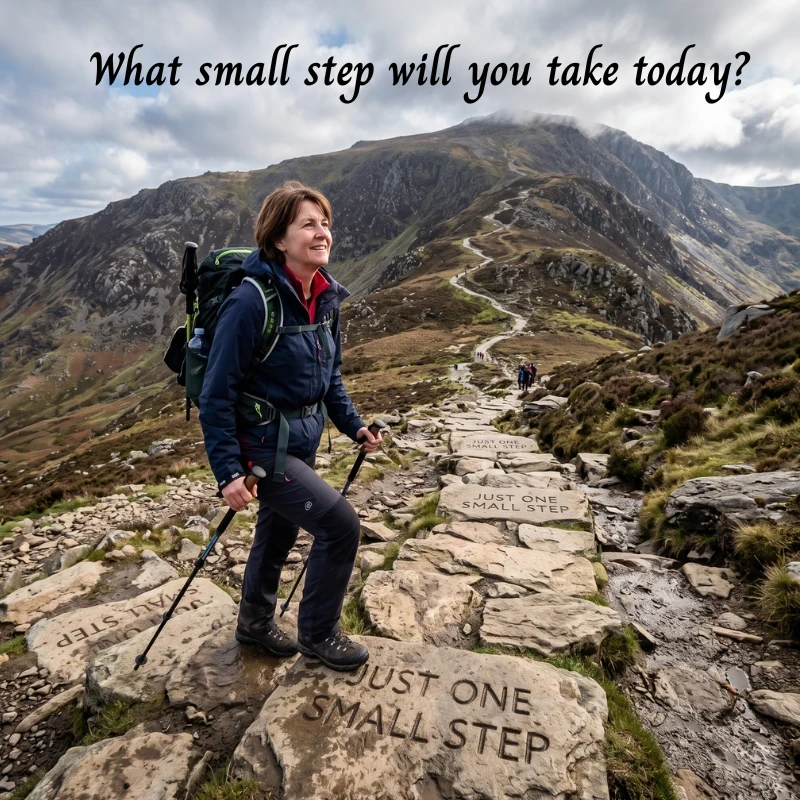
Try making the next step smaller.
Rather than deciding to write an entire report, open the document and write the heading. Instead of promising to exercise for an hour every day, begin with a ten-minute walk. Rather than trying to solve your whole future, identify one conversation you could have or one piece of information you could gather.
The step needs to be small enough to feel possible, but meaningful enough to move you forward.
You can also make the action more specific. “I need to work on my business” is broad and difficult to begin. “At 10 o’clock tomorrow morning, I will spend fifteen minutes drafting the first paragraph of my services page” gives your mind something concrete to follow.
Small actions may not feel dramatic, but they create evidence. Each time you take a step, you show yourself that movement is possible.
Replace criticism with curiosity
People often try to motivate themselves through self-criticism:
“Why can’t I just get a grip?”
“I’ve wasted another day.”
“I’m so lazy.”
The trouble is that shame and criticism can add to the uncomfortable emotions you are already trying to avoid.
A more compassionate response does not mean making excuses or giving yourself permission to remain stuck. It means recognising that there is a reason for the behaviour and becoming curious enough to try to understand it.
You might say:
“I notice that I’m avoiding this. I wonder what feels difficult about it?”
That question creates space for an honest answer. And a really honest answer gives you somewhere much more useful to begin.
When insight is not enough
Self-awareness is a powerful starting point, but sometimes we understand a pattern and still find it difficult to change.
This is often because the problem is not just held at the level of conscious thought. It may also involve an emotional response, a long-standing belief or an automatic association developed through past experience.
This is where coaching and therapeutic approaches can help.
Coaching can help you clarify what you want, identify what is getting in the way and create realistic steps towards change. Approaches such as hypnotherapy, NLP, EFT and EMDR Plus may also be used, where appropriate, to work with the thoughts, feelings and learned responses connected to a pattern.
There is no single approach that is right for everyone. The important thing is to understand you as an individual rather than trying to force you into a standard solution.
You are not failing at change
If you know what you want to do but cannot seem to make yourself do it, try not to use that struggle as evidence against yourself.
Your behaviour may be telling you that something needs attention.
Perhaps the goal is too large or unclear. Perhaps you are emotionally exhausted. Perhaps an old belief is creating doubt. Perhaps part of you is frightened of what will happen if you change, even when the change is something you genuinely want.
You do not need to fight that part of yourself. You can begin by listening to it and understanding what it is trying to protect you from. When you know this, you can then discover a different way forward.
Change does not always begin with more willpower. Sometimes it begins with a little more understanding.
Would you like some support?
If you recognise yourself in this article but are unsure what kind of support would be right for you, you are welcome to book a free 30-minute Discovery Session.
It is an informal opportunity for us to talk about what you would like to change, what may be getting in the way and whether working together feels right for you.
Book your free 30-minute Discovery Session.

Related posts
Cognitive Restructuring: How to catch a thought before it wrecks your day
Hi, Gail! The distinction between avoiding a task and avoiding the feeling attached to it lands hard, especially when a project carries the pressure to get every detail right. Do you find that people can usually identify the hidden belief on their own once they start asking these questions, or is that where an outside perspective becomes most useful?
I also wonder whether tracking a few tiny completed actions can help rebuild trust in yourself when perfectionism has made starting feel risky. The “small enough to accept” approach feels far more sustainable than trying to shame yourself into a massive reset.
Thanks so much!
Hi Aly. Thanks for reading and your thoughts here. In my experience, most people who have limiting beliefs and blocks like this would benefit from a coach or therapist helping them through because they tend to know which questions to ask. It’s not that people can’t do it on their own – they absolutely can – but that usually means reading a book, watching a video or having someone or something bring those questions into their own awareness. Everyone is different so there is nothing that works for everyone.
I also like your idea of tracking successes and this is part of the therapeutic or coaching process too.I’m glad you liked the article and feel free to visit again. Gail
This article offers a thoughtful perspective on the gap between knowing what to do and actually taking action. I particularly appreciate the emphasis on understanding the emotions and beliefs behind avoidance rather than simply labeling it as a lack of motivation or willpower. The suggestion to replace self-criticism with curiosity is especially valuable, as it encourages greater self-awareness and more constructive problem-solving. Breaking change into small, specific actions also provides a practical way to turn insight into meaningful progress.
Hi Kavitha, and thanks for taking the time to read and comment. I’m pleased you found the article helpful. One of the best things to do I think, is to break things down into manageable steps – that always works for me because I like to tick things off my list. Another way to do this, if you can’t separate the tasks easily, is to break it down by time – so you do say 1 hour on each task and then have a break. It’s like the Pomodoro method, if you know that, but it works for me.